
How to Design an Authentic Thai Restaurant Abroad
Learning how to design an authentic Thai restaurant abroad is about more than hanging a few elephants on the wall. Guests in Sydney, London or Los Angeles have travelled to Thailand, watched Thai food shows and eaten at dozens of Thai restaurants. As a result, they can tell the difference between a room that truly feels Thai and one that simply uses Thai clichés. In this guide, the design team at Queen Enterprise in Bangkok shares the practical steps we use when we design Thai restaurants for owners overseas, from the first concept to the moment your local contractor starts building.
Why authenticity matters for a Thai restaurant abroad
Most cities now have many Thai restaurants on the same street. Therefore, the menu alone rarely sets you apart. The room is often the first thing a guest judges, both in person and on social media. An authentic interior tells guests that the food is authentic too, and it gives them a reason to choose you over the shop next door.
Thailand itself takes this seriously. For example, the government-backed Thai SELECT program certifies authentic Thai restaurants overseas, and it now covers more than 2,000 restaurants in 76 countries, according to the Bangkok Post. An authentic Thai restaurant design supports the same promise of quality.
However, authentic does not mean old-fashioned. The best Thai restaurants abroad combine real Thai craft and culture with modern comfort, good lighting and an efficient layout. In other words, guests should feel Thailand, but the restaurant must still work like a modern business.
Step 1: Start with your food, your guests and your price point
Before you choose a single colour, define three things:
- Your food style. Royal Thai cuisine, Bangkok street food, Isan grilled dishes and southern seafood each suggest a different mood.
- Your guests. Families, office workers, couples on a date and tourists all use the space differently.
- Your price point. A fine dining room needs space, calm and soft light. In contrast, a fast casual shop needs speed, durable surfaces and bold graphics.
When these three answers are clear, the design direction usually follows naturally. For example, a premium Royal Thai menu fits carved timber and gold-line murals, while an Isan grill house fits bamboo, woven baskets and rice field imagery.
Step 2: Choose one clear story for your authentic Thai restaurant
A common mistake is to mix every Thai symbol into one room: temple roofs, elephants, Buddha images, tuk-tuks and beach photos all at once. Instead, choose one story and tell it well. Here are three directions we often develop for overseas owners:
- Royal Thai Heritage. Carved lattice screens, Khon masks, Ramakien murals, marble and warm brass. It suits fine dining, hotel outlets and premium mall locations.
- Bangkok Street. Thai script signage, market tiles, steel and colour, sometimes a Muay Thai theme. It suits fast casual restaurants, noodle bars and street food concepts.
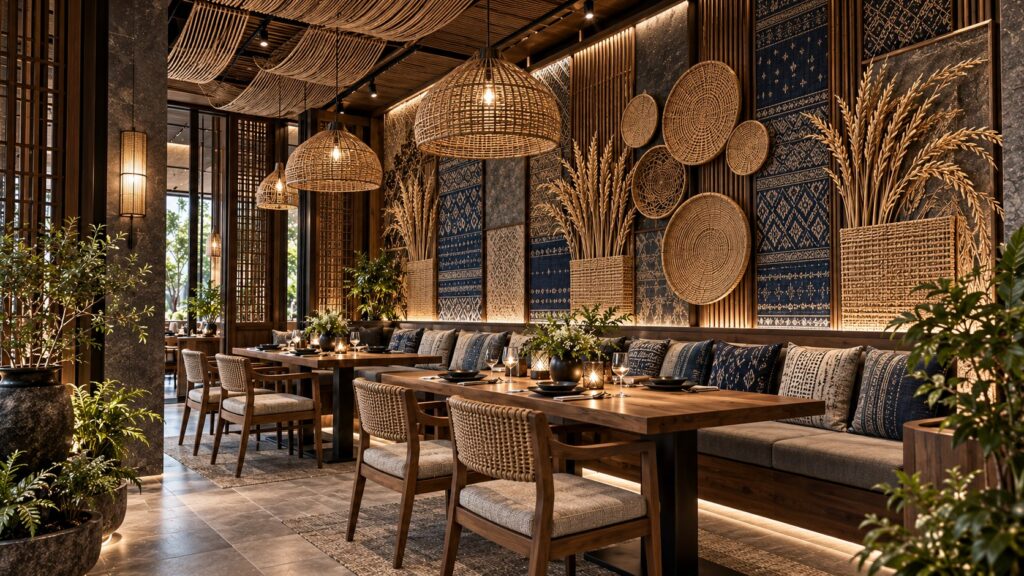
- Isan and countryside. Bamboo, rattan, indigo textiles and rice field art. It suits Isan food, Thai barbecue and brands with a natural, eco-friendly image.
You can see full examples of these directions in our Thai restaurant interior design concepts, which include images of each style.
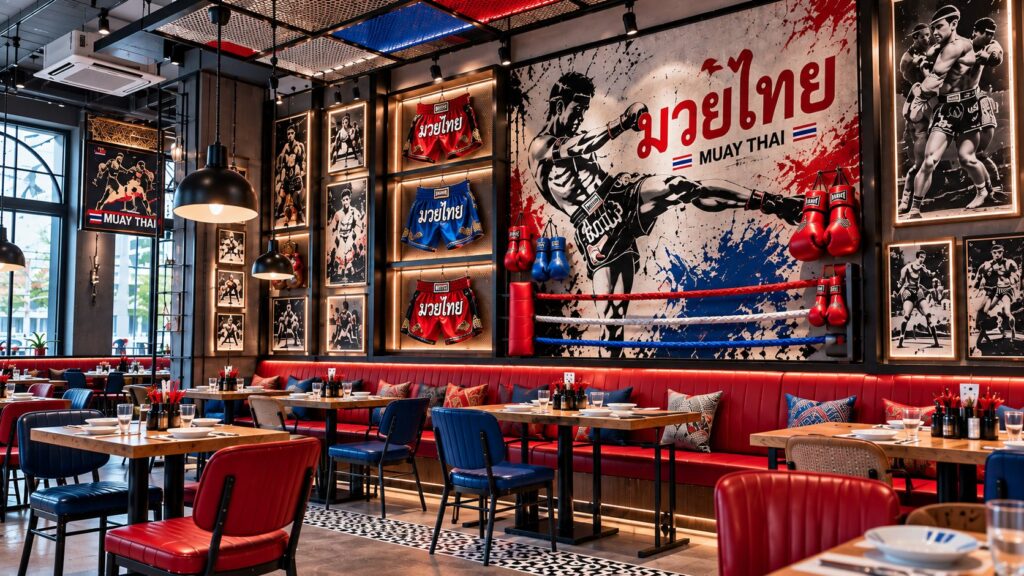
Step 3: Use real Thai materials and craft
Materials are where authenticity is easiest to feel. Guests touch the table, sit on the chair and look closely at the wall behind them. Consequently, a few real Thai pieces often do more than a large printed wallpaper. Consider these elements:
- Carved timber and lattice screens to divide zones and create soft patterns of light.
- Rattan and cane furniture, which is light, comfortable and recognisably Southeast Asian.
- Woven lamps based on fish traps, rice baskets or farmer hats.
- Thai textiles such as indigo mudmee or checked pha khao ma cloth for cushions, panels and uniforms.
- Celadon-style ceramics and stoneware for both décor and tableware.
- Terrazzo and natural stone, which recall older Bangkok shophouses and are easy to clean.
Many of these items are made by craft communities in Thailand. If you work with a Bangkok design team, they can source them directly and ship them with the rest of your fit-out.
Step 4: Respect Thai culture and religious symbols
This step is often forgotten abroad, but it matters to Thai guests and staff. Some images carry religious meaning and should be used with care, or not at all.
- Avoid using Buddha images as decoration, especially near toilets, on the floor or behind the bar.
- Place any spirit house correctly, at a respectful height and facing a suitable direction, and ask a Thai monk or elder for guidance if possible.
- Check every line of Thai script. Misspelled Thai signs are common in restaurants abroad, and Thai guests notice them immediately.
- Use the royal emblem, national symbols and temple elements thoughtfully, never as jokes or on items guests step on.
When the cultural details are right, Thai guests feel welcome. Moreover, they often recommend the restaurant to friends, which builds trust with everyone else.
Step 5: Plan the layout around how Thai food is served
Thai meals are usually shared, with many dishes arriving at once. As a result, tables need to be slightly larger than for a plated Western menu. Plan for space for rice, side dishes and condiment sets on every table.
- Table mix. Combine two-seat tables that join together with a few large round or long tables for groups.
- Banquettes. Long banquettes along the walls increase capacity and feel relaxed.
- Open kitchen or show station. A wok station, som tam counter or grill visible to guests adds theatre and builds trust in freshness.
- Takeaway and delivery. Many Thai restaurants abroad earn a large share from delivery, so give riders a separate pick-up point away from dining guests.
Step 6: Get the lighting and atmosphere right
Lighting changes everything. Warm light makes food look appetising and makes wood, rattan and gold details glow. In contrast, cold bright light can make even an expensive room feel like a canteen. We usually combine three layers: soft general light, focused light on each table, and accent light on art, screens and plants.
In addition, think about sound and scent. Soft Thai music, fabric panels to reduce noise, plants and a light lemongrass or jasmine scent at the entrance all help guests feel transported to Thailand without saying a word.
Step 7: Design for local building rules and your local contractor
Every country has its own fire, accessibility, ventilation and health rules. Therefore, the design must be adapted to local codes, and a local architect, engineer or contractor should check it before construction. A good remote design team prepares drawings that make this easy:
- Clear floor plans, ceiling plans, elevations and joinery details in English.
- Dimensions in metric or imperial units, as your contractor prefers.
- A finishes schedule listing every material, colour and supplier option.
- Online meetings with your contractor to answer questions during the build.
This approach lets you keep a Thai design team for the creative work while your trusted local builder handles permits and construction.
Step 8: Plan your budget wisely
An authentic Thai restaurant does not have to be expensive. Instead, put money where guests will notice it most: the entrance, one strong feature wall, lighting and seating. You can then keep other areas simple. For existing shops, a refresh of the feature wall, signage, lighting and décor can change the feeling of the room without a full rebuild.
Finally, compare the cost of design carefully. Hiring a Thai design team remotely is often more affordable than a local designer, and you gain cultural knowledge that is hard to find abroad.
How Queen Enterprise designs Thai restaurants for owners abroad
Queen Enterprise is an interior design, architecture and construction company based in Bangkok. For Thai restaurant owners overseas, we offer remote design packages that cover concept design, full drawings for your local contractor and sourcing of Thai décor and furniture. The process is simple:
- Send us your floor plan, photos and a short description of your menu and guests.
- We meet online to agree on the design direction and budget.
- We prepare the concept, 3D views and drawings, then refine them with your feedback.
- Your local contractor builds from our drawings, and we support them online.
To see our concepts, packages and pricing, visit our Thai restaurant interior design service page. You can also browse our completed projects or contact our team to discuss your restaurant.